sandustry · sandustry kinetic press
Sandustry Kinetic Press: Setup & Uses
Last verified: 2026-08-15
A Sandustry kinetic press jams for one specific reason: Burnt Slag has to fall into its processing window one piece at a time, and anything that lands on a piece mid-process fails to register. That failed piece hardens into an ordinary solid particle sitting on the press face. The next piece now drops from a shorter height onto that pile and fails too; within seconds the pile itself has become the launch pad, so nothing arriving can ever fall far enough — the line is dead until you clear it by hand. The developer has confirmed a genuine defect as well: occasionally the press simply fails to process a piece, and that one miss starts the same cascade. So the fix is never "feed it faster" — it is guaranteeing single-file arrival and sweeping away every miss.
What the press actually does
Unlocked at Refining 2, the Sandustry kinetic press is the only machine that handles burnt slag. You do not belt material into it — you drop burnt slag from height onto the zone marked with green arrows at placement. Each piece that lands cleanly breaks into one Gold and one spore, which makes slag a second income stream rather than waste. Two placement facts trip players up:
- Raw Slag, sand, water, or anything else in the chute is wasted — burn first, press second. Burn setups live in the Slag Burner guide.
- The description text mentioning a "soaker" is a confirmed leftover typo from when the machine was still called the Velocity Soaker. No shaker, soaker, or second building is involved.
Community density charts put burnt slag near 50, which is part of why a filter can isolate it so cleanly above the drop. Burning also shrinks volume dramatically — mechanics videos show a raw slag pile six tiles tall converting to under two tiles of burnt slag — so the press feed always takes less room than the slag box that produced it.
The jam, step by step
Understanding the cascade is what makes the six fixes obvious, so here is the sequence exactly as players and the developer have pieced it together:
- A piece of burnt slag lands inside the processing window and starts converting.
- A second piece touches it mid-window. The press can only register one, so the newcomer settles inertly as a plain solid particle on the press face.
- Every following piece now has a shorter drop, because the pile steals height — and a shorter drop means another failure.
- The pile grows into its own launch pad. From here, no piece can ever fall far enough, and the Sandustry kinetic press is functionally dead until someone clears the stack by hand.
The output side can kill it too. Spores are light and drain slowly; if the spore pile climbs to press height, incoming burnt slag lands on spores instead of the machine — a jam that looks identical to overfeeding but starts underneath.
The six anti-jam fixes
Ordered by impact, as assembled from the developer-answered Steam threads and community teardowns:
- Roof the drop with a filter that passes only burnt slag. The single highest-value change to any Sandustry kinetic press line. A filter trickles pieces through far slower than an open belt or launcher dump, spacing them naturally, and it stops spores, gold, and sand from ever reaching the drop zone.
- Keep at least five empty tiles below the press. Output needs room to fall; once the pile underneath rises to press height, behavior turns erratic. At full throughput spores alone can stack several tiles deep, so leave real headroom, not a token gap.
- Build the press one tile wide. Misses then tumble off the side instead of camping on the face, and you can gather the strays and drop them again. A wide press gives every miss a place to sit.
- Give misses a launcher exit. One at the bottom ejects buildup before it stacks; a second pointing straight up over the press pops a stuck piece off the face so it can drop cleanly. Recorded builds often aim these at the feed tube, so strays get thrown straight back into the riser.
- Cap the incoming belt at about two blocks of material height. A belt carrying a deep slug can deliver a whole pile in one moment — exactly what the window cannot handle. The cap is a physical limiter: nothing upstream can ever present more than two tiles at once.
- Separate multiple presses. Gaps or walls between them keep one press's spill from reaching the next; a stepped wall over the row fans the incoming stream out across every press instead of dumping the full flow onto the first.
Feeding it without floods
Throughput problems at a Sandustry kinetic press are really flow problems upstream. Three habits from mechanics-focused playthroughs:
- Throttle launchers feeding the drop. A full-power launcher throws more than the press can absorb; players deliberately weaken the throw — a block placed above the launcher mouth works — so pieces arrive as a stream.
- Let filters pace the input. Routing the drop through a filter roof means pieces can only fall at the filter's pass rate, which is slower than any belt.
- Split the stream across presses by height. A stacked divider sends the bottom layer to one press and the top layer to another; at low volume only the first press runs, so capacity follows load without rebuilding.
Minding the outputs
- Gold is heavier than spores and falls naturally, but it only adds to your balance inside collector blocks — box it.
- Spores are the sleeper problem. If spore drainage lags, a spore pile climbs above the press and incoming burnt slag lands on spores instead of the machine — the output-side jam described above. Give spores their own filter-gated exit toward your planter wing, and treat a slowing Sandustry kinetic press as a spore problem whenever the drop zone looks clean.
Unprocessed pieces are not lost: re-dropping them through the press converts them eventually, so a recirculating loop beats a trash chute.
The pre-flight checklist
Before blaming the machine, walk this list in order — it covers every jam cause confirmed so far:
- A burnt-slag-only filter roofing the drop zone.
- At least five tiles of empty clearance under the press.
- A one-tile-wide press so misses fall clear.
- A launcher below, and optionally above, clearing strays.
- Incoming belt capped near two blocks of material height.
- Gaps or a stepped wall between neighboring presses.
A Sandustry kinetic press that still stalls with all six in place is hitting the developer-confirmed random miss — which is exactly why the checklist exists: a rare miss must never get the chance to cascade.
Scaling from one press to a row
One filtered drip feed handles a starter shaker bank comfortably. When a full bank of shakers overruns a single Sandustry kinetic press, the recorded pattern is a split roof: a sloped divider fans the burnt slag across three presses, and a launcher at the bottom recirculates whatever arrives while all three are busy. Keep the burn wing away from flower beds and moss — demo-era patch notes flag embers as an ignition risk there. Size press count against measured slag volume, not ambition; the Processing Plant guide covers that plant-level math.
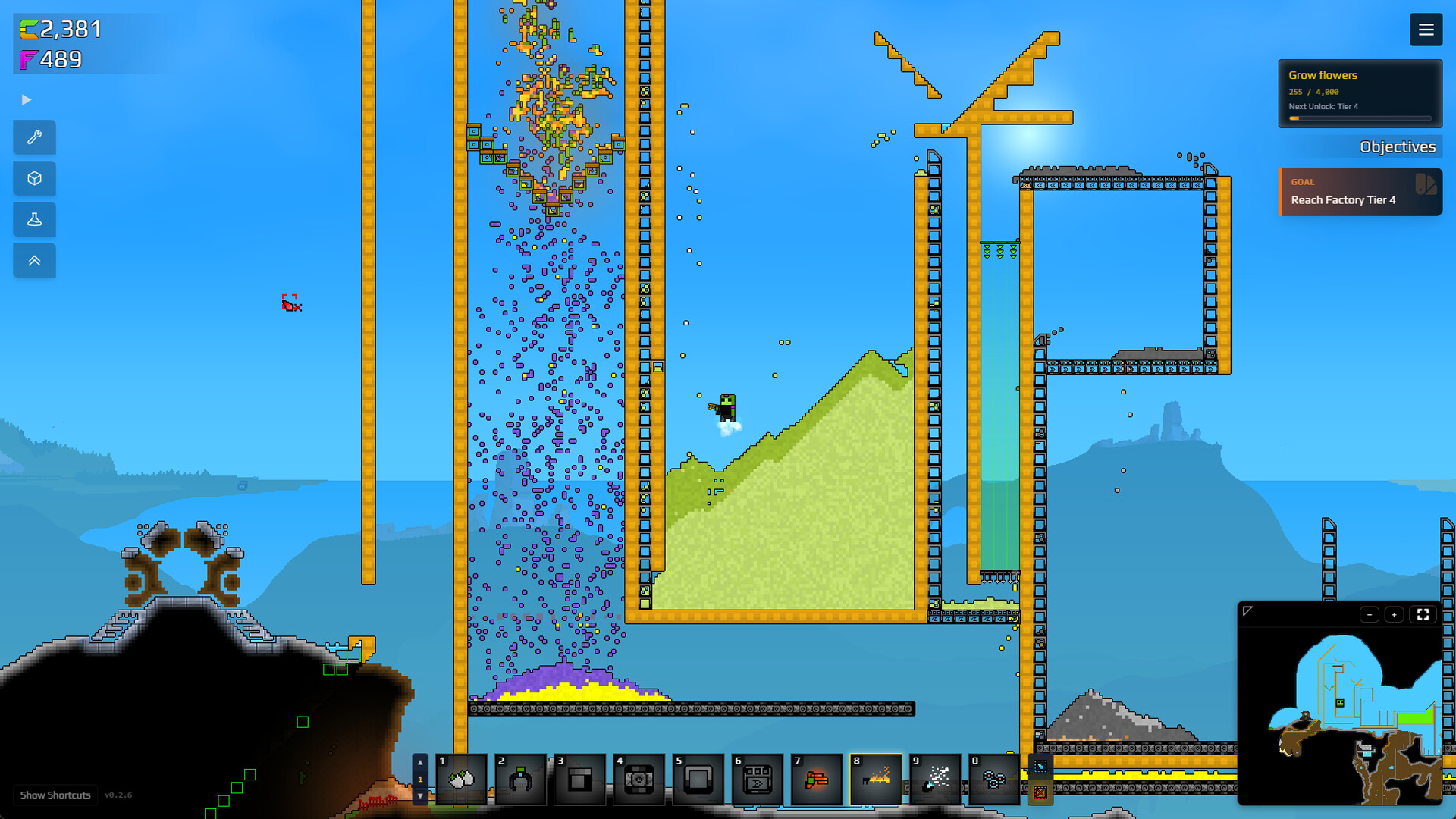
Watch it in action
FAQ
Why does my Kinetic Slag Press keep jamming?
Burnt slag must land one piece at a time inside a short processing window. A second piece arriving mid-window fails to register and becomes an inert solid particle; the pile that follows shortens the drop for everything after it until the line dies. Meter the feed with a filter set to burnt slag only.
What unlocks the Kinetic Slag Press?
The Refining 2 research tier. You also need a burn method — the flamethrower from Tools 1, or a lava bed — because the press accepts burnt slag only, never raw slag.
What does the press produce?
Each successfully processed piece of burnt slag breaks into one gold plus one spore on impact. Route gold into collector blocks (loose gold does not count) and drain spores away so they never stack up to the press.
Does the press need a shaker or a 'soaker' to work?
No. The building description mentions a soaker, but the developer confirmed that word is a leftover typo from the machine's old name, Velocity Soaker. Dropping burnt slag from height is the whole mechanism.
Can burnt slag the press missed be recovered?
Yes. Players report that missed pieces can be fed back through the drop until they convert.
How many presses should one factory run?
Start with a single Sandustry kinetic press fed through a filter drip. When a full shaker bank overruns it, split the stream across a row of three with a stepped divider, and size the count against measured slag volume rather than shaker count.
Sources
- Sandustry Toolkit: fix a jammed slag presshttps://sandustry.hunt-games.com/how-to/fix-kinetic-slag-press-jam/
- sandustry.wiki: Kinetic Slag Press building pagehttps://sandustry.wiki/buildings/kinetic-slag-press/
- sandustry.wiki: production line guidehttps://sandustry.wiki/production-chains/production-line/
- sandustry.wiki: Gold and Slaghttps://sandustry.wiki/materials/gold-slag/
- sandustry.wiki: How to Playhttps://sandustry.wiki/guides/how-to-play/
- Steam discussion: Kinetic Slag Press (developer replies)https://steamcommunity.com/app/2764460/discussions/0/603021130830195261/
- Steam discussion: player press-jam reporthttps://steamcommunity.com/app/2764460/discussions/0/599646033658540489/
- IdoraAlphyGaming mechanics explainer (captions)https://www.youtube.com/watch?v=x5NVrMO-R5A
- Official Sandustry sitehttps://sandustry.com/
- Sandustry on Steam (app 2764460)https://store.steampowered.com/app/2764460/Sandustry/
- Official launch trailerhttps://www.youtube.com/watch?v=-m7xp1q24Qw